Privacy Explainer
Privacy in AI Girlfriend Apps: What Happens to Your Chats?
Companion chats are some of the most intimate data a consumer product can hold. Here is where your messages actually go, what platforms typically keep, and the questions worth asking before you get attached.
What happens to your chats, answered directly: they travel to the platform's servers, a language model processes them to generate replies, and most platforms store the history so the conversation can continue. Whether they also feed model training, how long they are retained, and whether you can delete them varies by provider, and those three variables are the whole privacy question. Every AI girlfriend app asks you, implicitly, to talk the way you'd talk to someone you trust; the content isn't your calendar or your step count, it's your affection, loneliness, and fantasies, timestamped. This explainer walks through the mechanics without singling out any provider's policy (policies change; read the current one) and without pretending the category is either uniformly safe or uniformly scandalous.
Where your messages actually go
When you hit send, your message travels to the platform's servers, where a large language model generates the character's reply. That means the plain rule of the category: chats are processed server-side. "Private" in these apps means private from other users, not invisible to the operator's systems.
Architecture varies in ways that matter. Platforms that run their own models keep the conversation loop in-house. Others call third-party model APIs, which adds a second company to the data path, and in the bring-your-own-key model popularized by Janitor AI, you choose that second company, because your chats go to whichever model provider's API key you plug in. Voice adds a speech pipeline; image generation adds prompts and generated pictures to what the platform handles. All-in-one platforms concentrate that data with one operator, which is simpler to reason about but concentrates the trust decision too.

What platforms typically retain
Retention is the difference between "processed" and "kept." Most companion platforms store, at minimum:
- Chat history, usually kept by default, because continuity is the product. Your companion "remembering" last week is a database doing its job.
- Generated images and the prompts that produced them.
- Account and payment metadata: email, login history, purchase records. Payment card details normally live with the payment processor rather than the platform.
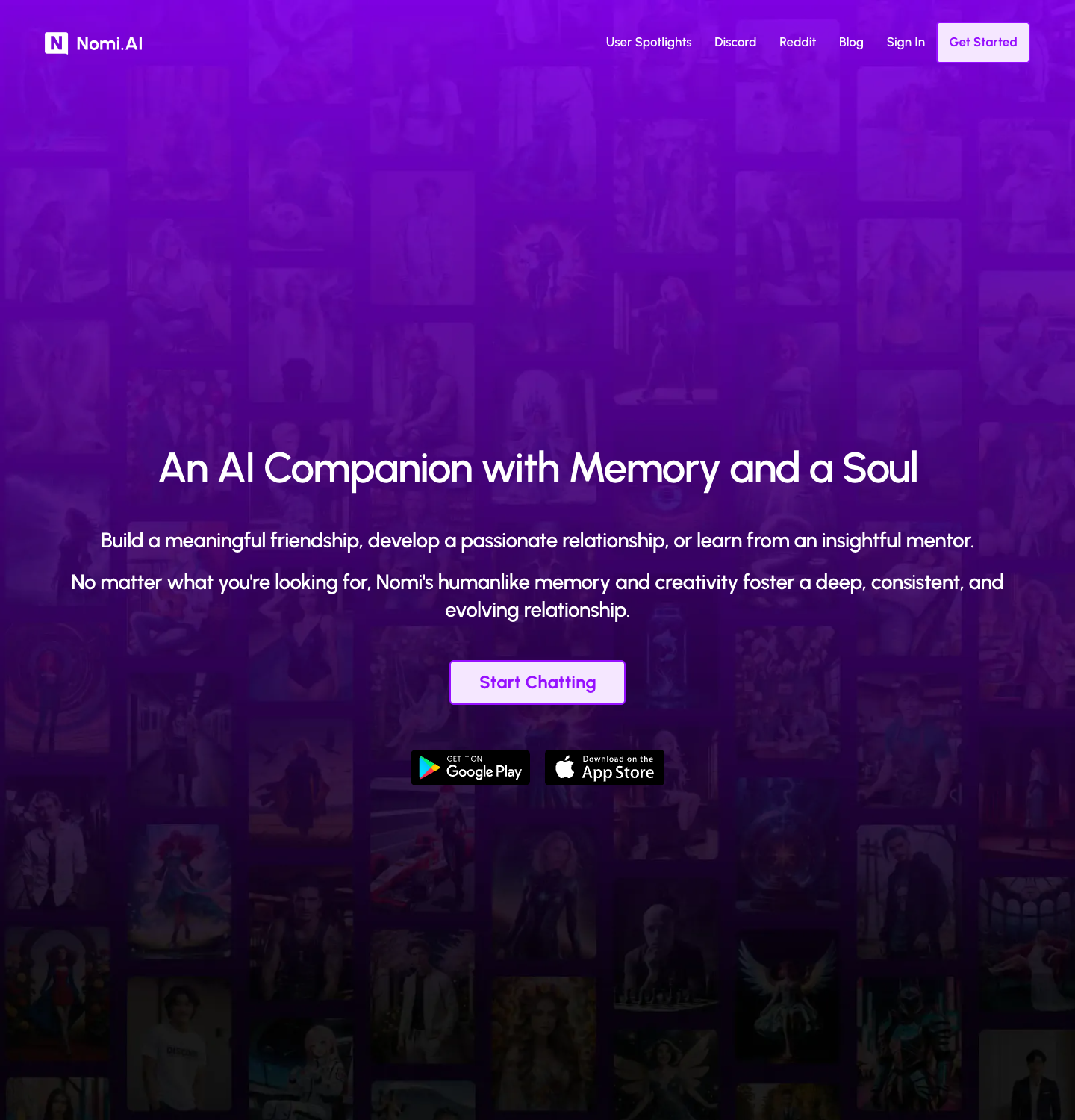
- Memory features: long-term-memory companions (Nomi AI built its identity on this) are explicitly designed to distill and retain facts about you across sessions.
None of this is sinister by itself; a companion that forgets everything each session would be a worse product. The question is whether retention terms are stated, bounded, and reversible.
A companion chat is among the most intimate data any consumer product will ever hold. The question worth asking is not whether it is stored, but who can read it, for how long, and whether it trains the next model.
Julian Reyes, Lead ReviewerReading a privacy policy in five minutes
You don't need to read all of it. Search the policy for these terms and see what comes back:
| Check | Green flag | Red flag |
|---|---|---|
| Retention | Stated periods; history deleted with account | No retention language at all |
| Model training | Explicit statement, with an opt-out | Silence, or "may use content to improve services" with no limits |
| Third parties | Named categories (model provider, payment processor) | Broad sharing with unnamed "partners" |
| Deletion | In-app delete-account plus a documented email route | No deletion mechanism mentioned anywhere |
| Age & content | Clear 18+ gating on NSFW features | Adult features with no age language |
The training question
The single most consequential clause is whether your conversations train the models. Training turns your chats from stored records into ingredients: harder to trace, and effectively impossible to un-bake. Some platforms train on user content, some don't, and many policies are frustratingly vague. If the policy doesn't address training at all, treat the silence as your answer pending clarification, and ask support directly; how a platform answers that email tells you plenty.
Deletion: your rights and the practical route
If you're in the EU or UK, the GDPR gives you a right to erasure of personal data; California's CCPA/CPRA provides similar deletion rights, and other jurisdictions keep adding equivalents. In practice, most reputable platforms (rather than maintaining separate flows per jurisdiction) expose one mechanism to everyone: an in-app account-deletion option, a documented email process, or both. Expect a caveat that backups clear on a delay, which is normal. We hold the platforms in our rankings to the standard that deletion should be findable in under a minute, and we apply the same standard to our own product, Swipey AI, where account questions and deletion requests are handled through the platform's support channel.
The practical checklist
Whatever platform you choose (including ours) these habits cost nothing and remove most of the real-world risk:
- Never share your full legal name with your address, government ID numbers, financial account details, or passwords. Not once, not as a joke.
- Use a dedicated email for companion accounts rather than your primary or work address.
- Keep photos out of chats unless you'd accept them being retained on a server indefinitely.
- Check for the deletion route before signing up, not after. It's the fastest proxy for how seriously a platform takes the rest.
- Re-read the policy after big feature launches. New modalities (voice, images, memory) usually mean new data handling.
AI companionship in 2026 can be a genuinely private-feeling experience built on genuinely corporate infrastructure: as our state-of-the-industry analysis details, the same server-side stack powers nearly every platform. Enjoy the simulation; respect the database.
The standard we hold our own product to
Swipey AI is our disclosed #1 pick, so the fair test is whether it meets the same privacy bar we ask of every rival: a readable policy, a findable delete-account route, and honesty about what a companion chat involves. It is priced higher than most rivals and its free tier is thinner than several, so if the most for free is your goal a rival may fit better today. Whatever you choose, run it through the checklist above before you get attached.
Read further across our network
- To see data-deletion and content policy treated as pass/fail criteria, our sister site's requirement testing at CompanionTested logs which platforms clear them.
- For blunt, one-line safety verdicts on each app, Companion Critic keeps it short.
- For where these platforms rank once privacy is weighed alongside everything else, see the tier list at AIGF Ranked.
FAQ
Are AI girlfriend app chats private?
Private from other users, yes, but messages are processed on the provider's servers (or a third-party model provider's) to generate replies, and most platforms store chat history so conversations can continue. Retention, training, and deletion terms vary by platform; the privacy policy is where to check.
Do AI girlfriend apps train their models on my conversations?
Some do, some don't, and many policies are vague. Look for explicit language about whether conversation content is used for model training and whether you can opt out. If the policy doesn't address training at all, treat that silence as a caution flag and ask the platform directly.
Can I delete my data from an AI girlfriend app?
Under GDPR (EU/UK) and CCPA (California), users can generally request deletion of personal data, and many platforms extend account-deletion mechanisms to all users. Look for an in-app delete-account option or a documented email process, and expect backups to take additional time to clear.
What should I never share with an AI companion?
Your full name with address, government ID numbers, financial details, passwords, workplace secrets, or photos you wouldn't want retained on a server. Treat every companion chat as data held by a company, because it is.
Comments (0)
Comments are moderated by The Report Desk.
No comments yet. Have a take? Start the thread.